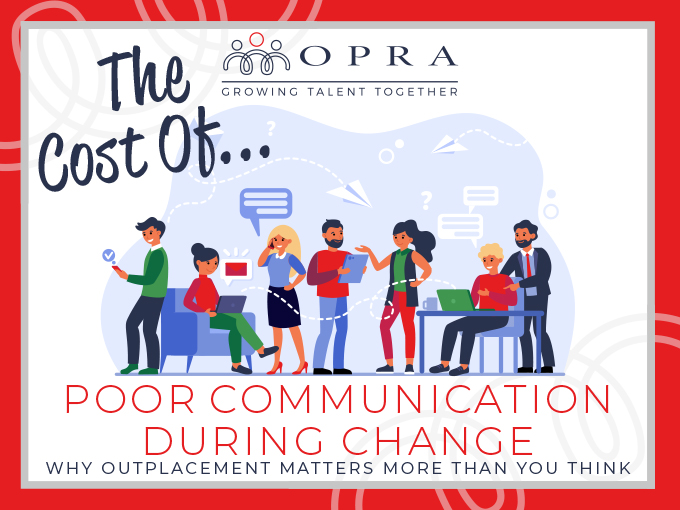
Why Outplacement Matters More Than You Think
Change is inevitable. Poor communication during change is not, and yet it’s one of the most expensive leadership mistakes organisations continue to make.
Restructures, redundancies, mergers, leadership shifts. These moments define how people remember your organisation. Not because of what changed, but because of how it was communicated.
When communication is unclear, delayed, or avoided altogether, the cost shows up fast, and it runs deep.
What poor communication during change really costs
1. Trust erosion
Silence creates stories, and they’re rarely positive. When people don’t hear from leaders, they fill the gaps themselves. Trust, once lost during change, is incredibly hard to rebuild.
2. Productivity loss
Uncertainty paralyses performance. Employees spend time worrying, speculating, and disengaging instead of focusing on their work.
3. Talent drain
Your top performers don’t wait around in unclear environments. Poorly communicated change pushes high-value people out, often the very people you hoped to retain.
4. Reputation damage
How you treat people during change travels far beyond your walls. Candidates, clients, and partners are all watching, and listening.

Where outplacement makes the difference
Outplacement is often misunderstood as a ‘nice-to-have’ during difficult transitions. In reality, it’s a powerful communication tool.
Handled well, outplacement says:
- We planned this change carefully
- We respect the people affected
- We take responsibility for the impact of our decisions
Handled poorly, or not at all, the message is the opposite.
Outplacement supports individuals through transition, but it also supports the organisation by:
- Reducing anxiety and uncertainty
- Protecting employer brand
- Demonstrating values in action
- Helping remaining employees feel safe, informed, and respected
It turns a moment of loss into a moment of leadership credibility.
Change doesn’t fail because of the decision, it fails because of the silence around it
Most organisations focus heavily on what is changing:
- Structures
- Roles
- Headcount
- Strategy
Far fewer give the same attention to how the change is communicated, explained, and supported.
That’s where the real cost lies.
Leading change well means communicating early, clearly, and humanely
Effective change communication:
- Starts before rumours do
- Acknowledges uncertainty honestly
- Explains the ‘why’, not just the ‘what’
- Supports those leaving and those staying
- Aligns actions with stated values
Outplacement is not just an exit solution, it’s a leadership statement.
At The OPRA Group, we work with organisations to manage change in a way that protects people, performance, and reputation, because how you lead during the hardest moments is what defines your culture long after the change is over.
#TheCostOf #Leadership #ChangeManagement #CommunicationMatters #Outplacement #HRLeadership #PeopleFirst #OrganisationalChange #EmployerBrand