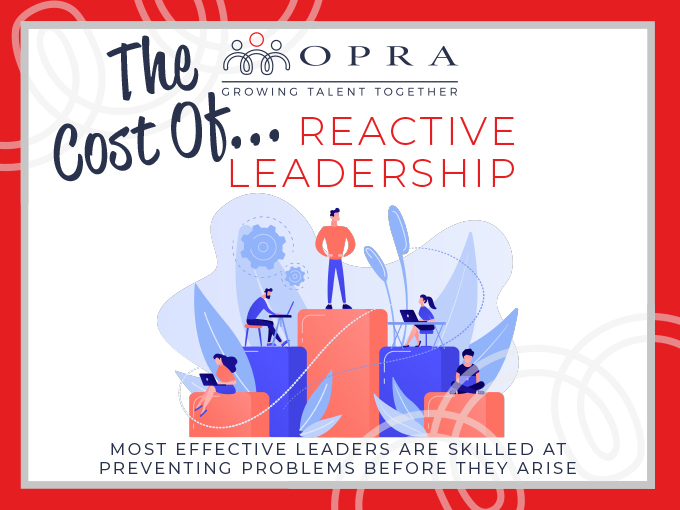
Leadership is often measured by how well someone responds when things go wrong. We feel the most effective leaders aren’t simply good at reacting, they’re skilled at preventing problems before they arise.
When leaders spend most of their time firefighting, making last-minute decisions, or responding to crises, they enter a cycle of reactive leadership. While this approach may solve immediate issues, it often comes at a significant cost to the organisation, its people, and its long-term success.
As part of our “The Cost Of…” series, we’re exploring how reactive leadership can quietly undermine business performance, and what organisations can do instead.
What is reactive leadership?
Reactive leadership occurs when leaders are constantly responding to events rather than anticipating them. Decisions are made under pressure, priorities shift frequently, and strategic thinking takes a back seat to urgent operational demands.
It can develop for many reasons:
• Rapid organisational growth
• Ongoing staffing shortages
• Poor planning or unclear objectives
• Limited leadership development
• Constant organisational change
• Lack of reliable people data or insight

The hidden costs
Reduced employee engagement
Employees thrive when expectations are clear, communication is consistent, and leaders provide direction.
Reactive leadership often creates uncertainty. Priorities change without explanation, decisions appear inconsistent, and employees spend more time adapting to changing demands than focusing on meaningful work.
Over time, this uncertainty reduces engagement, motivation, and trust in leadership.
Higher levels of stress and burnout
When every week feels like a crisis, pressure becomes the norm.
Leaders working reactively often experience decision fatigue and exhaustion, while their teams feel the impact through unrealistic deadlines, constant interruptions, and competing priorities.
Eventually, high-performing employees begin to disengage—or leave altogether.
Slower decision-making
Ironically, reacting quickly doesn’t always mean making decisions efficiently.
Without strategic planning, leaders often revisit the same issues repeatedly, seek approval at every stage, or make rushed decisions that require further correction later.
The result is lost productivity and delayed progress.
Increased employee turnover
People rarely leave organisations because of one difficult week.
They leave when uncertainty becomes permanent.
Inconsistent leadership, unclear direction, and constant change without purpose can all contribute to increased turnover. Replacing experienced employees is costly, not only financially but also in lost knowledge, disrupted teams, and reduced customer confidence.
Lost opportunities
Organisations focused solely on today’s problems rarely have the capacity to prepare for tomorrow.
Innovation, talent development, succession planning, and strategic improvement often fall down the priority list when leaders are constantly dealing with immediate operational challenges.
The opportunity cost can be significant.
Why proactive leadership matters
Proactive leaders don’t eliminate problems, they reduce the likelihood and impact of them.
They invest time in planning, communicate expectations clearly, develop future leaders, and use data to identify emerging risks before they become major issues.
This creates organisations that are:
• More resilient during change
• Better equipped to retain talent
• More productive and engaged
• Faster to adapt without creating unnecessary disruption
Proactive leadership also builds confidence. Employees understand the organisation’s direction, managers make decisions with greater consistency, and teams spend less time responding to avoidable crises.
How HR can help shift the balance
HR plays a critical role in helping organisations move from reactive to proactive leadership.
By providing workforce insights, supporting leadership development, strengthening performance management, and encouraging strategic workforce planning, HR helps leaders focus on long-term success rather than short-term survival.
This isn’t about removing every challenge. It’s about creating the conditions where leaders have the confidence, capability, and support to make informed decisions before problems escalate.
Questions every organisation should ask
If your leaders spend most of their time solving yesterday’s problems, it may be worth asking:
1. Are we planning ahead or constantly responding to events?
2. Do our managers have the skills and support to lead proactively?
3. Are our people clear about priorities and expectations?
4. What recurring issues keep resurfacing, and why?
5. Are we creating space for strategic thinking, or only making time for urgent tasks?
Small changes in leadership approach can have a lasting impact across an organisation.
Final thoughts
Reactive leadership isn’t a reflection of poor leadership, it is often a symptom of wider organisational pressures.
However, when reacting becomes the default way of working, organisations can expect lower engagement, higher turnover, increased stress, and missed opportunities.
The most successful organisations recognise that leadership isn’t measured by how many fires are extinguished. It’s measured by how many are prevented in the first place.
Creating proactive leaders doesn’t happen overnight, but investing in leadership capability today can significantly reduce the organisational costs tomorrow.
At The OPRA Group, we work with organisations to strengthen leadership capability, develop resilient teams, and create people strategies that support sustainable business success. Because preventing problems is always more effective, and less costly, than constantly reacting to them.